"
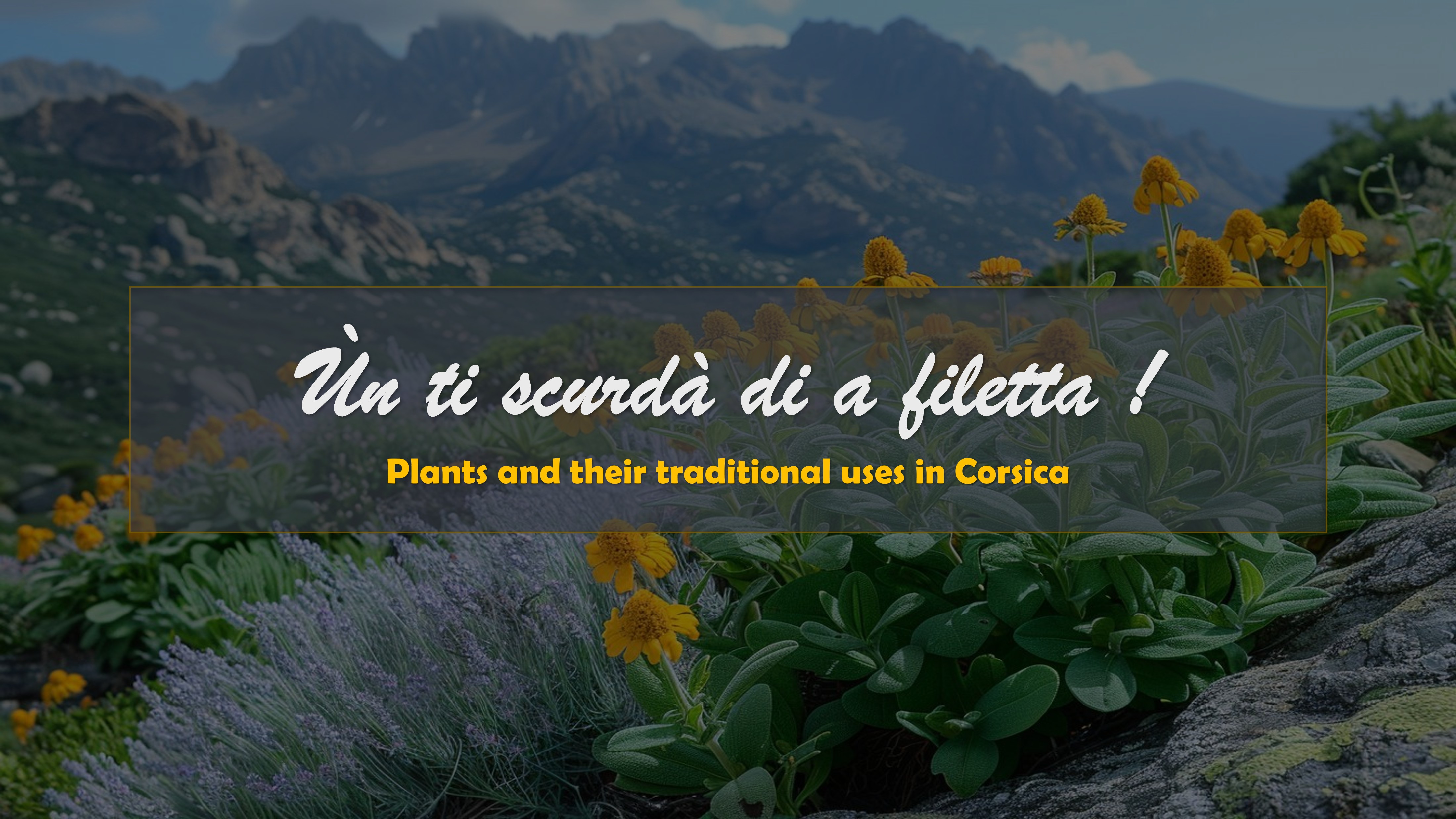
Nature plays an essential role in Corsican society. Of someone who forgets their roots, people say: 'Ùn cunnosce più a filetta'. This exhibition explores the bonds between humans and plants in a Corsican society that was predominantly agro-pastoral until the second half of the 20th century, through the lens of ethnobotany and ethnolinguistics.
GENESIS OF THE EXHIBITION

A living heritage threatened by oblivion

For centuries, the Corsicans maintained a deep relationship with the plants of their territory, built on knowledge passed down orally from generation to generation. Medicine, food, construction, music, beliefs ; plants were at the heart of every daily gesture.

It is this intangible heritage, today fragile, that this exhibition seeks to document, value and transmit through the combined lens of ethnobotany and ethnolinguistics.

SCIENTIFIC APPROACH

Crossing disciplines to reveal knowledge

This project was born from fieldwork carried out with the last custodians of this knowledge. Each panel brings together linguistic data, ethnographic sources and botanical analyses, through the lens of ethnobotany and ethnolinguistics. The Corsican names of plants are themselves archives. This interdisciplinary approach aims to make previously scattered knowledge accessible, anchoring it in its island and Mediterranean context. This exhibition is the result of a partnership between the Réseau Canopé de Corse, the University of Corsica and the Conservatoire Botanique National de Corse (CBNC) of the Office de l'environnement de la Corse, and was funded by the Collectivité de Corse.

The team behind the exhibition
Scientific team
Muriel Poli
Scientific conception
Université de Corse - LISA UMR 6240
Marie-Françoise Saliceti
Scientific conception
Université de Corse
Anne-Solen Gourdon
Scientific conception
Conservatoire Botanique National de Corse
Caroline Favier-Vittori
Contributor
 
Isabelle Istria
Botanical illustrations
 
Fabienne Terrone-Cianfarani
Scenography & design
Réseau Canopé de Corse
Zéïnab Aly Camara
Graphic Design
Student · Università di Corsica
Nine ways Corsica lived with its plants
Exhibition panels
Each panel explores a different use of plants in traditional Corsican society, from the lullaby sung at the children's bedside to the fish traps woven by fishermen. One territory, nine perspectives.

Click on the icon  to display a panel.

Click and hold, then move the mouse to rotate in 3D.

01 Impennà
Plants in oral literature
Plants have been a millennial source of inspiration in Corsican oral literature: legends, proverbs, sayings and songs with often anonymous authors. Traditional lullabies (e nanne) glorify nature. In A nanna di u bambinu, Paul-Mathieu de la Foata lulls the child to sleep with the scent of violet, thyme and mint. Species such as heather (a scopa) or the cornflower (fior d'alisu) also nourish Corsican musical heritage.
a scopa - heather fior d'alisu - cornflower a viola - violet u timu - thyme
02 Sunà
Music and traditional instruments
Popular music accompanies Corsican community customs: religious festivals, pagan celebrations, agricultural work, weddings and mourning. So-called 'ephemeral' instruments, reed flutes (a pirula, a cialamella), chestnut-bark trumpet (a tromba), rattle (a ragana), jaw harp (a riverbula), are made from plants and rarely survive the test of time. String instruments are made of maple, walnut or pear wood.
a canna - reed u castagnu - chestnut l'aceru - maple u nuciaru - walnut
03 Crede
Beliefs and traditions linked to plants
Many plants are linked to local customs, Catholic religious calendars and pagan beliefs. The olive tree, everlasting flower, St John's wort and orpine are believed to protect against fire and storms. Heather, cursed since a biblical episode, is banned from churches. The strawberry tree, which supposedly hid Mary and Jesus, is venerated. Box is used to decorate the bride's arch. Wild asparagus adorns the Nativity scene.
u bussu - box u bacu - strawberry tree a scopa - heather u fiori di San Ghjuvanni - St John's wort
04 Edificà
Plants in construction
Corsica has various tree species distributed according to altitude. Chestnut is the most widely used wood for roof timbers, floors and furniture. Beech was used for chairs. Juniper (u ghjineparu) and alder are renowned for being rot-proof in water and are used for lintels and mill wheels. Thorny shrubs, hawthorn, blackthorn, broom, were used to make impenetrable natural hedges for cultivated plots.
u castagnu - chestnut u ghjineparu - juniper l'alzu - alder u faghu - beech
05 Curà
Medicinal plants
Before synthetic medicines, wild plants treated everyday ailments. Mallow (a malva), elderberry (u sambucu), violet and bramble have soothing properties. Diuretic plants such as pellitory or arba sciappapetra treated kidney stones. For burns and rheumatism, St John's wort (u fiori di San Ghjaseppu), yarrow (l'arba santa) and nettles were used. Today, the market for medicinal plants is booming.
a malva - mallow u sambucu - elderberry l'arba santa - yarrow a vitriola - pellitory
06 Curà l'animali
Treating animals with plants
In Corsica, veterinary phytotherapy was passed down from generation to generation among livestock farmers. A decoction of ash kept animals healthy. The toxic sap of hellebore (a nocca) was used as a wound disinfectant. Shepherds made peula, a juniper pitch to kill parasites. To stimulate lactation, ivy was given to goats. At birthing time, buplever (u tristacu) and spurge laurel (u pateddu) were used.
u frassu - ash tree a nocca - hellebore a lellara - ivy u pateddu - spurge laurel
07 Cucinà
Plants in traditional cooking
Edible wild plants (arbigliule) have long inspired Corsican popular cooking. Gathered from the countryside, they formed the base of herb tarts (a torta / a bastella / a sciaccia erbosa), soups or salads. These include poppy, mint, bladder campion, borage, dandelion and nettle. Aromatics such as rosemary, bay, nepita, fennel and chamomile accompany meats and sauces. Myrtle, arbutus berry, sloe and gentian are used to make jams and spirits.
a murta - myrtle u bacu - arbutus berry a nepita - wild mint u finochju - fennel
08 Nutrisce l'animali
Feeding animals with plants
In the agro-pastoral tradition, plants are known and named according to their properties for animals. Lupin (u lupinu) was gathered, threshed and ground to feed pigs. Barley, vetch and clematis served as fodder. Giant fennel, edible when green, becomes toxic and deadly when dry. Spurge laurel is highly toxic to humans despite its berries being enjoyed by partridges. This knowledge gave rise to many expressions in the Corsican language.
u lupinu - lupin a ferula - giant fennel u pateddu - spurge laurel a nocca - hellebore
09 Custruice
Making objects with plants
Maquis trees and shrubs provide the raw material for everyday objects. Shepherds made cheese moulds (e fattoghje) in rush, juniper pails and milking stools (a prevula) in giant fennel. Brooms were of heather, baskets of willow, mattresses of maize leaves or asphodel. Alder wood was used to make clogs and mill wheels. Myrtle was used to weave fish traps and needles for mending nets.
u ghjuncu - rush a scopa - heather a murta - myrtle l'asfoldu - asphodel